Why Large Organizations Struggle to Decide and Why It Kills Innovation
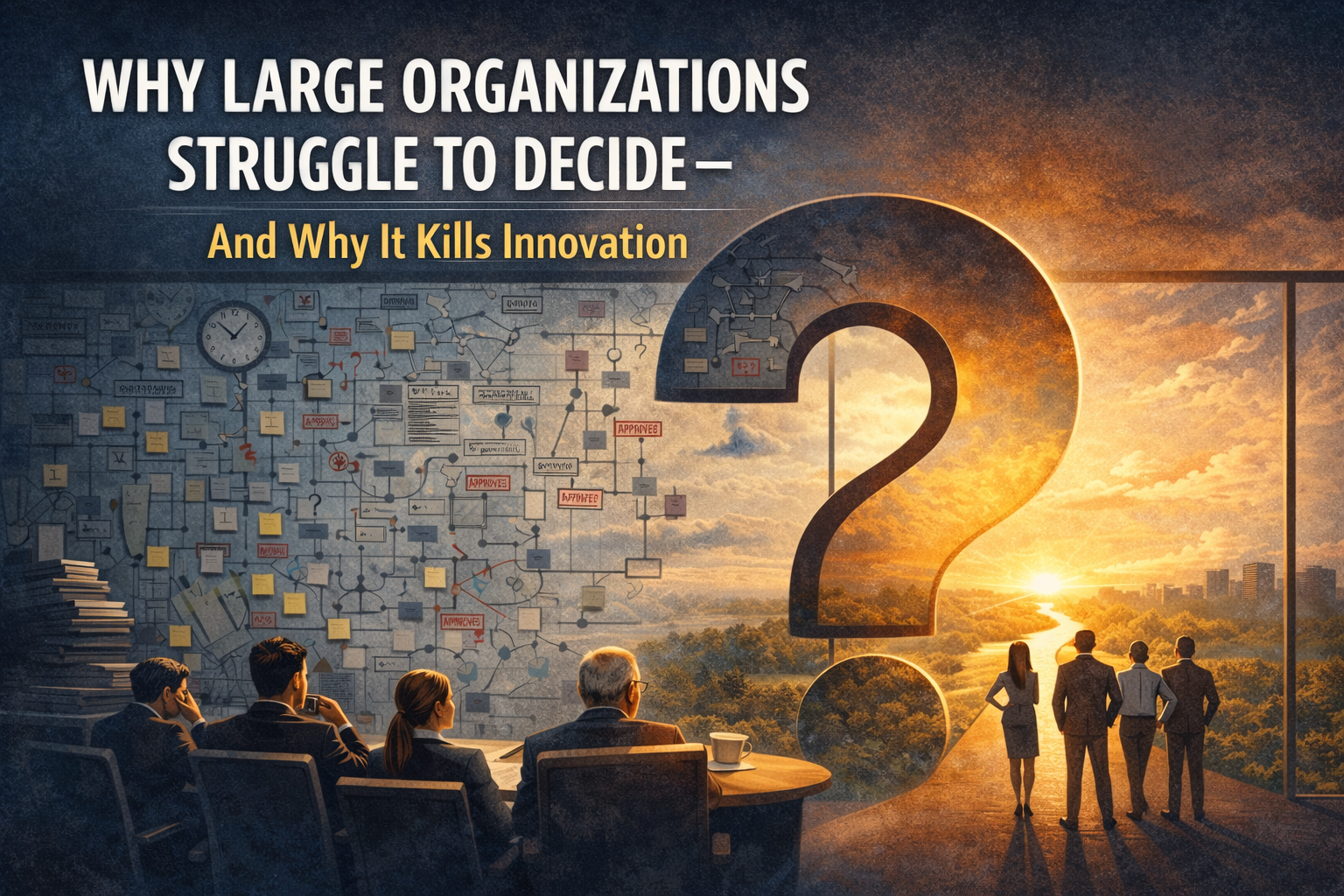
How many times has this happened?
A workshop is scheduled with the right people in the room, yet no one is fully clear on what decision is actually supposed to be made. The conversation is thoughtful. People share their points of view. Different functions bring useful perspectives. It becomes a good moment for alignment, for surfacing concerns, for hearing each other out. But when the session ends, no real decision has been made.
How many times does the calendar fill up with calls, check-ins, alignment meetings, and steering committees, while the real work remains stuck? Everyone is busy. Everyone is involved. Everyone seems engaged. And yet, week after week, nothing truly moves forward.
How many projects get delayed even when no meaningful new information is expected to arrive? The facts are already on the table. The options are understood. The trade-offs are visible. Still, the decision does not come. The topic is discussed again, moved to another meeting, or escalated one level higher.
This frustration is not anecdotal. It is a common pattern in large organizations.[1][3][13]
The Scale of the Problem
This is not a marginal issue.
In large organizations, decision making absorbs an enormous amount of leadership capacity. Senior executives spend nearly 40% of their time making decisions, and a majority say that much of this time is used poorly. For some C-suite roles, the share can reach 70% of managerial time.[1]
The cost is not only personal frustration or calendar overload. In a typical Fortune 500 company, ineffective decision making has been estimated to waste about 530,000 days of managers’ time per year, equivalent to roughly $250 million annually in wages.[1]
The pattern also appears at the company level. Among firms that stop creating value, 85% of CEOs attribute the problem primarily to internal factors such as complexity rather than to external market conditions. The same research argues that only about 11% of large public companies become sustained value creators over time.[3]
This matters because the issue is not simply that large organizations hold too many meetings. It is that they consume extraordinary amounts of time and managerial energy without generating the speed and clarity required to move. When that happens, delay stops being a nuisance and becomes a structural cost.[1][3]
That is where the innovation risk becomes obvious.
Innovation depends on timely decisions under imperfect information. But when a large organization burns leadership capacity on slow, repetitive, or unresolved decision processes, it becomes harder to learn quickly, harder to commit resources, and harder to adapt before the market moves on.[4]
In large organizations, decision friction is not just a cultural annoyance. It is a measurable drain on time, money, and innovation capacity.[1][4]
Why Slow Decisions Kill Innovation
Innovation does not fail only because organizations lack ideas. It often fails because they cannot make decisions fast enough to turn ideas into action.[4]
That is the real danger of decision friction in large organizations. It does not simply slow execution. It slows learning.[4]
Innovation is not a linear process in which all the facts become clear before the right move is obvious. It is a process of testing, choosing, adapting, and committing under uncertainty. When decisions are delayed, experiments start later, feedback arrives later, resources are reallocated later, and the organization learns later than the market moves.[4]
This is why slowness is so damaging. In mature organizations, delay often looks responsible. More reviews are added. More stakeholders are consulted. More alignment is requested. But innovation rarely benefits from endless circulation. It benefits from momentum, clear choices, and the ability to move before certainty is complete.[4]
The consequence is that innovation becomes performative. There are workshops, pilots, governance forums, and strategy decks, but the organization struggles to convert them into timely commitments. Ambition remains high, but readiness to act remains low.[4][5]
This matters even more because innovation is not only about creativity. It is also about operating model. Organizations with stronger innovation cultures are 60% more likely to be innovation leaders, and those that combine culture with the right operating mechanisms are nearly twice as likely to become world-class innovators.[6]
And when that system is too slow, the cost compounds. Opportunities weaken. Energy drains out of teams. Promising initiatives lose sponsorship. Competitors learn faster. By the time a large organization is ready to commit, the window to lead may already have closed.[4]
Innovation needs more than ideas. It needs an organization that can decide before the opportunity expires.
Why Large Organizations Struggle to Decide
The problem usually does not begin with incompetence. It begins with scale.
As organizations grow, they add business units, geographies, product lines, governance forums, reporting lines, and cross-functional interfaces. Each addition is usually sensible on its own. It helps coordinate more activity, reduce risk, or create consistency. But over time, the combined effect is often a system with more dependencies, more handoffs, and more friction between issue and action.[7]
One consequence is that alignment becomes easier to organize than decisions.
Workshops, steering meetings, and cross-functional reviews can be genuinely useful. They surface different perspectives, help teams understand trade-offs, and create broader alignment. But in many large organizations, these forums stop there. The discussion is rich, the participation is high, and mutual understanding improves, yet no one leaves with a clear decision, a single owner, or an explicit commitment.[8]
A second cause is lack of ownership.
As more stakeholders are brought into a topic, accountability often becomes diluted. Many people are consulted. Several leaders are invited to contribute. Different functions are asked to align. Yet the more inclusive the process becomes, the less clear it may be who is actually expected to make the call. In that environment, discussion expands while ownership fades. Research on decision roles makes the same point: role proliferation does not automatically create accountability.[9]
And this is where culture matters.
In some organizations, people do not hesitate because they are incapable. They hesitate because the environment makes hesitation safer than commitment. Escalating an issue feels safer than deciding. Asking for another round of input feels safer than exercising judgment. Participating in the discussion feels safer than owning the outcome.[10][15]
Some leaders do push through this. They take ownership, make decisions, and create momentum in their own area. And very often, that produces real local performance. Teams move faster. Priorities become clearer. Execution improves. But in most large organizations, individual drive is not enough to change the wider system. Over time, the same structural inertia catches up. Dependencies remain. Other functions move more slowly. Decisions still get delayed elsewhere. What begins as strong local leadership often turns into recurring frustration when the broader organization cannot match the same speed and accountability.
This is especially true when leaders do not create clear decision space.
If senior leaders remain too close to operational choices, teams wait for signals instead of acting. If boundaries are vague, authority feels conditional. If people are told they are accountable but are not truly given decision rights, ownership becomes symbolic rather than real.[11]
Bureaucracy then reinforces all of this.
Rules, controls, and approval steps are not inherently bad. Large organizations need standards and discipline. But when these mechanisms become excessive, they shift the organization toward procedural safety and away from adaptive speed. The company becomes better at processing issues than resolving them. Delay starts to look normal because the system has been optimized to minimize risk more than to sustain momentum.[12]
This is why slow decision making in large organizations is rarely caused by one bad leader or one broken process.
It is usually the product of several forces working together: rising complexity, alignment without commitment, diluted ownership, and a culture in which caution is rewarded more reliably than decisive leadership. Once those forces combine, decision friction stops being an exception and becomes part of the operating model.[8][9][10][12][15]
Large organizations become slow not only when complexity increases, but when ownership fades and the culture stops expecting people to decide.
What Effective Organizations Do Differently
Large organizations do not solve this problem by trying to eliminate complexity altogether. They solve it by ensuring that complexity does not take control of decisions.
The first difference is clarity.
Effective organizations are far more explicit about which decisions truly matter, who owns them, and what input is needed before a call is made. They do not treat every issue as if it deserves the same level of consultation, review, and escalation. Instead, they distinguish between high-stakes decisions that require broader involvement and routine decisions that should be made quickly, close to the work.[2][13]
The second difference is real ownership.
Strong organizations do not confuse participation with accountability. They make it clear who is responsible for recommending, who provides input, and who ultimately decides. That clarity matters because once too many people feel partial ownership, no one feels fully accountable.[2][9]
The third difference is empowerment with boundaries.
Better decision making does not come from pushing every issue upward. It comes from giving teams the authority, context, and guardrails to decide at the right level. That requires more than delegation in name only. It requires a clear strategy, well-understood boundaries, and leaders who resist the instinct to pull decisions back upward whenever risk appears.[11][13]
Another difference is discipline around when to wait and when to decide.
Not every fast decision is a good decision, and sometimes waiting is justified. But the key question is simple: will waiting create meaningful new information or new learning? If the answer is yes, delay may improve the quality of the decision. If the answer is no, waiting is usually not a strategy but avoidance. Effective organizations are better at making this distinction. They do not confuse postponement with prudence. This principle is an inference from the broader research on decision quality, speed, and learning rather than a direct quote from a single source.[1][4][13]
The fourth difference is that meetings are designed with a clear purpose.
Effective organizations are disciplined about why a meeting exists in the first place. Some meetings are for decision making. Others are for information sharing. Others are for alignment, discussion, or problem solving. Confusion starts when these purposes are mixed or left implicit. A meeting that is actually for discussion gets treated as if it should produce a decision. A meeting that should lead to a decision ends without one because the goal was never made explicit.[8][14]
The fifth difference is culture.
Organizations that decide well do not rely only on process. They reinforce behaviors. They reward speed with judgment, not just caution. They make decision quality and decision timeliness part of leadership expectations. And they build an environment in which taking responsibility is valued more than staying safely adjacent to the choice. Research links stronger decision-focused cultures with better decision effectiveness and faster growth.[15]
This is also why reducing bureaucracy matters, but only to a point.
The goal is not to remove all structure. The goal is to preserve enough structure for consistency while creating enough flexibility for speed, accountability, and adaptation. The organizations that perform best are not the least organized. They are the ones that balance control with responsiveness.[12]
In the end, the difference is simple.
Less effective organizations build systems that help people participate in decisions. More effective organizations build systems that help people make them.
The organizations that innovate best are not the ones with fewer decisions to make. They are the ones that make important decisions with greater clarity, ownership, and speed.
Conclusion
Large organizations do not usually lose innovation because they lack talent, ideas, or ambition.
They lose it because, over time, they allow decision making to become slower, heavier, and less accountable than the pace of the environment around them.[1][3][4]
That is what makes this issue so important. It is not just about frustrating meetings, overloaded calendars, or projects that move too slowly. It is about whether the organization can still turn judgment into action before the opportunity passes.[4]
The most dangerous part is that this decline rarely happens in a dramatic way.
It happens gradually. A few more layers are added. A few more stakeholders are involved. A few more reviews are requested. A few more decisions are delayed in the name of alignment, caution, or governance. Each step seems reasonable. But over time, the cumulative effect is an organization that keeps discussing while others keep moving.[3][7][12]
And that is where innovation starts to weaken.
Because innovation is not only about generating ideas. It is about deciding under uncertainty. It is about moving before perfect certainty exists. It is about learning faster than the environment changes. When an organization loses that capability, it may still look busy, intelligent, and well managed from the inside. But it becomes slower to adapt, slower to commit, and slower to create real progress.[4][5][6]
This is why decision making should be treated as a strategic capability.
Not every delay is a failure. Not every fast decision is a good one. But when waiting is no longer expected to create new information or new learning, delay stops being prudence and starts becoming avoidance. And when that pattern becomes cultural, innovation does not need to be rejected explicitly. It gets exhausted by inertia.[4][10][15]
The organizations that will perform best in the future are not necessarily the ones with the most resources, the most processes, or the most alignment. They will be the ones that can preserve clarity, ownership, and momentum even as they grow.[6][12][13][15]
Because in the end, innovation is not just a matter of ideas.
It is a matter of whether the organization can still decide.
Large organizations do not fall behind when they stop talking about innovation. They fall behind when they can no longer decide fast enough to sustain it.[4][5]
References
[1] McKinsey. Decision making in the age of urgency. https://www.mckinsey.com/~/media/McKinsey/Business%20Functions/Organization/Our%20Insights/Decision%20making%20in%20the%20age%20of%20urgency/Decision-making-in-the-age-of-urgency.pdf
[2] McKinsey. Three keys to faster, better decisions. https://www.mckinsey.com/capabilities/people-and-organizational-performance/our-insights/three-keys-to-faster-better-decisions
[3] Bain. Killing Complexity Before Complexity Kills Growth. https://www.bain.com/insights/killing-complexity-before-complexity-kills-growth/
[4] Harvard Business Review. Drive Innovation with Better Decision-Making. https://hbr.org/2021/11/drive-innovation-with-better-decision-making
[5] BCG. Innovation Systems Are in Need of a Reboot. https://www.bcg.com/publications/2024/innovation-systems-need-a-reboot
[6] BCG. An Innovation Culture that Gets Results. https://www.bcg.com/publications/2023/innovation-culture-strategy-that-gets-results
[7] McKinsey. Beyond matrix organization, the helix organization. https://www.mckinsey.com/capabilities/people-and-organizational-performance/our-insights/the-helix-organization
[8] McKinsey. Plan a better decision meeting. https://www.mckinsey.com/capabilities/people-and-organizational-performance/our-insights/want-a-better-decision-plan-a-better-meeting
[9] McKinsey. The limits of RACI and a better way to make decisions. https://www.mckinsey.com/capabilities/people-and-organizational-performance/our-insights/the-organization-blog/the-limits-of-raci-and-a-better-way-to-make-decisions
[10] Harvard Business Review. Leaders, Stop Avoiding Hard Decisions. https://hbr.org/2018/04/leaders-stop-avoiding-hard-decisions
[11] McKinsey. For smarter decisions, empower your employees. https://www.mckinsey.com/capabilities/people-and-organizational-performance/our-insights/for-smarter-decisions-empower-your-employees
[12] BCG. Bureaucracy in Business: Finding the Balance. https://www.bcg.com/publications/2020/changing-business-environment-pushing-end-to-bureaucracy
[13] McKinsey. Make faster, better decisions. https://www.mckinsey.com/capabilities/people-and-organizational-performance/our-insights/make-faster-better-decisions
[14] McKinsey. How to run effective meetings. https://www.mckinsey.com/featured-insights/mckinsey-explainers/what-is-an-effective-meeting
[15] Bain. Create a decision-focused culture. https://www.bain.com/insights/decision-insights-7-create-a-decision-focused-culture/